
Delivering effective resolution while reducing undue burden
The SRB is committed to ensuring an effective, proportionate and predictable resolution framework that safeguards financial stability while contributing to a competitive EU banking sector. Simplification supports this objective by streamlining processes, reducing unnecessary burdens, and enabling authorities and banks to focus on the most relevant risks.
Without contradicting its mandate, the SRB continues to implement practical measures to simplify how the resolution framework operates in practice and to support further integration within the Banking Union.
This webpage provides an overview of actions underway. A detailed summary is available for download and will be updated periodically to reflect progress.
- Download - SRB approach to simplification (PDF)
- Latest update: Q4 2025
Why simplification matters
An efficient, integrated and predictable resolution framework is central to a competitive and resilient European banking sector. It enables banks to focus resources on the areas that matter most and reinforces confidence among investors, markets and citizens.
The SRB will continue working with national, European and international partners to support practical, smart and forward-looking simplification that strengthens resolution outcomes.
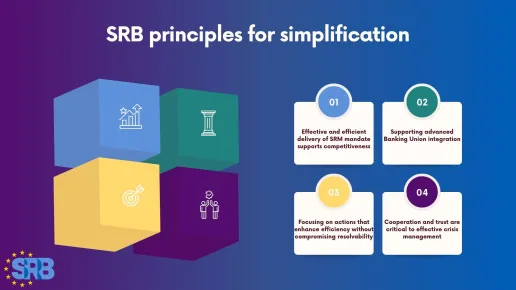
SRB principles for simplification
- Effective and efficient delivery of SRM mandate supports competitiveness
A resilient banking system fosters confidence and drives economic growth. Simplification aims to alleviate unnecessary burdens while maintaining financial stability, appropriate loss-absorbing capacity or crisis readiness. - Supporting advanced Banking Union integration
Harmonised rules and a more integrated market reduce fragmentation and facilitate simpler, more predictable procedures for banks and authorities. - Focusing on actions that enhance efficiency without compromising resolvability
Simplification efforts should support – not weaken – crisis preparedness. The SRB focuses on actionable measures it can implement directly, while also recommending legislative improvements when warranted. - Cooperation and trust are critical to effective crisis management. The framework must remain firmly anchored in internationally agreed standards -particularly the FSB Key Attributes - which underpin cross-border cooperation across jurisdictions.
Three pillars of SRB simplification
Below you can explore the SRB’s ongoing simplification actions. Each section provides a summary of initiatives and expected benefits.
1. Information & reporting requirements
Objective: Streamlining data requests and increasing predictability for banks and authorities.
Key Actions
- Reducing the burden of data requests
Supporting EU initiatives aiming to reduce reporting costs, eliminating duplication and contributing to integrated reporting frameworks. - Lower frequency for deliverables that have reached maturity
When legally possible and where banks have achieved a stable level of resolvability, updates will no longer be required annually but only when justified by material change. - Prior permissions
Prior permission procedures have been streamlined in line with SRB practices to make authorisation more agile. - Waiving or simplifying elements of SRF data collection
The SRB and NRAs will explore opportunities to reduce data requests where alternative reliable sources exist.
Benefit: Reduced reporting complexity and greater predictability.
2. Frequency & intensity of planning and testing
Objective: A more proportionate and risk-focused approach to resolution planning.
Key Actions
- Towards a multi-year resolution planning cycle
In line with SRM Vision 2028, the SRB proposes to legislators a gradual shift to a two- or three-year planning cycle where appropriate. - Targeted resolvability testing and coordinated on-site inspections
Testing programmes will remain central but increasingly risk-based, coordinated with other authorities to limit duplication. - Review of simplified obligations
Exploring ways to expand simplified regimes for more low-impact banks. - Developing digital solutions to facilitate analysis and reduce manual processes
Development of tools to automate workflows and improve decision processes.
Benefit: Focus on material risks and more efficient use of resources.
3. Clear, predictable and stable guidance
Objective: Stability of policies enables better planning, compliance and investment decisions.
Key Actions
- Transparent consultations and hearings
The SRB engages stakeholders early through public consultations and exchanges. - Predictability through structured planning cycles
Annual publication of upcoming requests and policy intentions. - Impact analysis for future policy changes
Ensuring guidance remains proportionate and aligned with resolvability objectives.
Benefit: Increased certainty for the banking sector and clearer implementation paths.